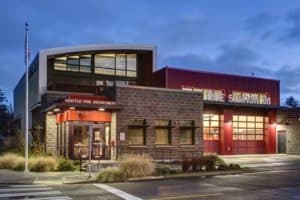
 I could map out my shoots and photograph two locations in the morning and two in the evening. Still, I was in for a project that lasted longer than I thought it would. With 35 stations and the weather being what it is in Seattle, what I thought would be a couple weeks turned into almost two months. At least I was doing this during the time of year when the days are the shortest. I couldn’t imagine doing a project like this during the Summer when dawn is at 4am and dusk is at 10pm…of course, that would have helped with the problem of rush-hour traffic.
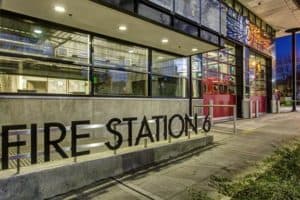 Every time a photographer takes on a project, one of the principal challenges is to find what makes that subject different. It didn’t take long to realize I needed to include the station number…what good is a photo of station #6 if you don’t know it’s station #6? The number was like a “signature”. Each subject has one, it’s up to the photographer to find it and capture it. The second aspect I needed to capture was the American flag. All fire stations have them and it seemed an obvious omission if I left it out.
With those thoughts in mind, I set out on quite a few mornings and evenings to see what I could capture. Turns out Seattle’s fire stations are beautiful architecture; not just a few here and there, but most of them. What started as a “I think I’ll shoot some of the fire stations” turned into what some might call an obsession. I had to shoot. If it wasn’t raining, I wanted to be out the door in the morning on my way to the next shot. Sometimes, that meant climbing out of bed, grabbing a coffee to go and out the door in less than 15 minutes. Other times, it meant delaying dinner or choosing a restaurant based on the fire station I could shoot along the way.
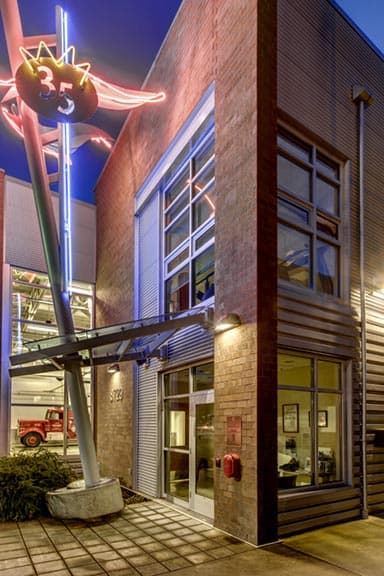 Once on site, I had to quickly decide what shots I would have time for and how to avoid car and foot traffic. WaStation35BThese images would be made available for stock sales and I wanted to avoid the problem of model releases. A wide angle lens helps in most situations but at other times I was across a busy street with a longer lens. One of the big issues was color balance. With ambient light being so far into the blue side of the spectrum, interior lights being on the opposite side and street lights being somewhere I could never really figure out, the post production could be a challenge for some locations. Fortunately, Seattle started upgrading to LED street lights a few years ago, so there were some stations that were bathed in beautiful white light. Then there was the station whose station number was a huge sculpture of neon light. Artistic, yes, but a color balancing nightmare.
The challenges were many..both astheticly and technically, but in the end it was well worth it. After nearly two months, 35 stations and almost 200 images, I’m glad I chose this project. I wonder what I’ll do next year.
Recent Comments